Webserver User Doesn't Have Read/write/execute Access to the Torrents Directory.
Linux is a clone of UNIX, the multi-user operating organization which tin can exist accessed by many users simultaneously. Linux can also exist used in mainframes and servers without whatsoever modifications. But this raises security concerns equally an unsolicited or malign user tin corrupt, alter or remove crucial data. For constructive security, Linux divides authorization into ii levels.
- Ownership
- Permission
In this Linux file commands tutorial, you will learn-
- Linux File Ownership
- Linux File Permissions
- Changing file/directory permissions in Linux Using 'chmod' control
- Absolute(Numeric) Style in Linux
- Symbolic Mode in Linux
- Changing Ownership and Group in Linux
The concept of Linux File permission and ownership is crucial in Linux. Here, we will explicate Linux permissions and ownership and volition discuss both of them. Let us start with the Ownership.
Click here if the video is non accessible
Linux File Ownership
Every file and directory on your Unix/Linux organization is assigned iii types of owner, given below.
User
A user is the owner of the file. By default, the person who created a file becomes its owner. Hence, a user is also sometimes called an owner.
Group
A user- grouping can comprise multiple users. All users belonging to a grouping volition accept the aforementioned Linux group permissions admission to the file. Suppose you have a project where a number of people require access to a file. Instead of manually assigning permissions to each user, you could add all users to a group, and assign grouping permission to file such that only this group members and no one else can read or modify the files.
Other
Any other user who has admission to a file. This person has neither created the file, nor he belongs to a usergroup who could own the file. Practically, it means everybody else. Hence, when you set the permission for others, it is also referred as set permissions for the world.
Now, the large question arises how does Linux distinguish betwixt these iii user types so that a user 'A' cannot touch a file which contains some other user 'B's' vital data/data. It is similar y'all do non want your colleague, who works on your Linux computer, to view your images. This is where Permissions set in, and they define user behavior.
Permit us sympathise the Permission system on Linux.
Linux File Permissions
Every file and directory in your UNIX/Linux system has following 3 permissions divers for all the 3 owners discussed to a higher place.
- Read: This permission give you the authority to open and read a file. Read permission on a directory gives you the ability to lists its content.
- Write: The write permission gives you the authority to change the contents of a file. The write permission on a directory gives you the authority to add, remove and rename files stored in the directory. Consider a scenario where you have to write permission on file but do non take write permission on the directory where the file is stored. You will be able to modify the file contents. Simply y'all will not be able to rename, move or remove the file from the directory.
- Execute: In Windows, an executable plan usually has an extension ".exe" and which you can easily run. In Unix/Linux, you cannot run a program unless the execute permission is set. If the execute permission is not prepare, you might still be able to see/modify the programme lawmaking(provided read & write permissions are set), only non run it.
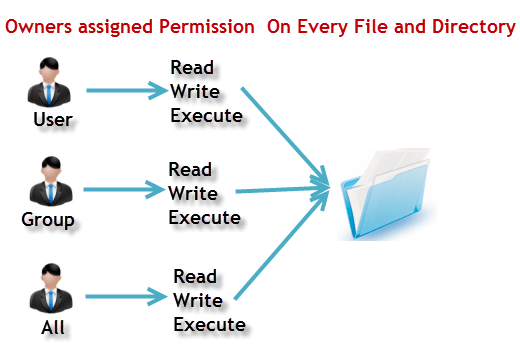
Let'due south see file permissions in Linux with examples:
ls – l on concluding gives
ls - l

Hither, we have highlighted '-rw-rw-r–'and this weird looking lawmaking is the i that tells u.s. about the Unix permissions given to the owner, user group and the earth.
Hither, the first '–' implies that nosotros have selected a file.p>

Else, if it were a directory, d would have been shown.

The characters are pretty easy to recall.
r = read permission
w = write permission
x = execute permission
– = no permission
Let us wait at it this manner.
The showtime part of the code is 'rw-'. This suggests that the owner 'Dwelling' can:

- Read the file
- Write or edit the file
- He cannot execute the file since the execute bit is fix to '-'.
By design, many Linux distributions like Fedora, CentOS, Ubuntu, etc. will add users to a group of the aforementioned group name as the user proper noun. Thus, a user 'tom' is added to a grouping named 'tom'.
The second part is 'rw-'. It for the user grouping 'Dwelling house' and group-members can:
- Read the file
- Write or edit the file
The tertiary part is for the world which means whatsoever user. It says 'r–'. This means the user can only:
- Read the file
.png "File Permissions in Linux/Unix")
Changing file/directory permissions in Linux Using 'chmod' command
Say you practise not want your colleague to meet your personal images. This can be achieved by changing file permissions.
We tin can use the 'chmod' control which stands for 'change mode'. Using the command, we tin can set up permissions (read, write, execute) on a file/directory for the owner, group and the world.
Syntax:
chmod permissions filename
There are 2 means to employ the command –
- Accented style
- Symbolic mode
Accented(Numeric) Manner in Linux
In this style, file permissions are not represented equally characters merely a iii-digit octal number.
The table below gives numbers for all for permissions types.
| Number | Permission Blazon | Symbol |
|---|---|---|
| 0 | No Permission | — |
| 1 | Execute | –x |
| 2 | Write | -w- |
| iii | Execute + Write | -wx |
| four | Read | r– |
| 5 | Read + Execute | r-x |
| six | Read +Write | rw- |
| 7 | Read + Write +Execute | rwx |
Let's see the chmod permissions command in action.
.png "File Permissions in Linux/Unix")
In the higher up-given terminal window, we have changed the permissions of the file 'sample to '764'.
.png "File Permissions in Linux/Unix")
'764' absolute lawmaking says the following:
- Possessor tin can read, write and execute
- Usergroup tin can read and write
- World can only read
This is shown as '-rwxrw-r–
This is how you can alter user permissions in Linux on file by assigning an accented number.
Symbolic Way in Linux
In the Accented style, y'all modify permissions for all 3 owners. In the symbolic mode, you can alter permissions of a specific possessor. It makes use of mathematical symbols to modify the Unix file permissions.
| Operator | Description |
|---|---|
| + | Adds a permission to a file or directory |
| – | Removes the permission |
| = | Sets the permission and overrides the permissions set up earlier. |
The various owners are represented every bit –
| User Denotations | |
|---|---|
| u | user/possessor |
| g | group |
| o | other |
| a | all |
We will not be using permissions in numbers like 755 but characters like rwx. Let's look into an example
.png "File Permissions in Linux/Unix")
Changing Ownership and Group in Linux
For irresolute the buying of a file/directory, yous can use the following control:
chown user filename
In case you want to alter the user as well as group for a file or directory apply the command
chown user:group filename
Let's come across this in action
.png "File Permissions in Linux/Unix")
In example you want to change grouping-owner just, utilise the command
chgrp group_name filename
'chgrp' stands for change group.

Tip
- The file /etc/group contains all the groups divers in the system
- You can use the command "groups" to find all the groups you are a fellow member of
- Y'all can employ the command newgrp to work every bit a member a group other than your default grouping
- Y'all cannot have 2 groups owning the aforementioned file.
- Y'all practice non have nested groups in Linux. One group cannot be sub-group of other
- 10- eXecuting a directory means Being immune to "enter" a dir and proceeds possible access to sub-dirs
- In that location are other permissions that yous tin set on Files and Directories which volition be covered in a afterwards avant-garde tutorial


Summary:
- Linux being a multi-user organisation uses permissions and ownership for security.
- There are three user types on a Linux system viz. User, Group and Other
- Linux divides the file permissions into read, write and execute denoted by r,w, and 10
- The permissions on a file can be changed by 'chmod' command which tin be further divided into Absolute and Symbolic mode
- The 'chown' command can modify the ownership of a file/directory. Use the post-obit commands: chown user file or chown user:group file
- The 'chgrp' command can change the group ownership chrgrp group filename
- What does x – eXecuting a directory mean? A: Being allowed to "enter" a dir and proceeds possible access to sub-dirs.
Source: https://www.guru99.com/file-permissions.html

Post a Comment for "Webserver User Doesn't Have Read/write/execute Access to the Torrents Directory."